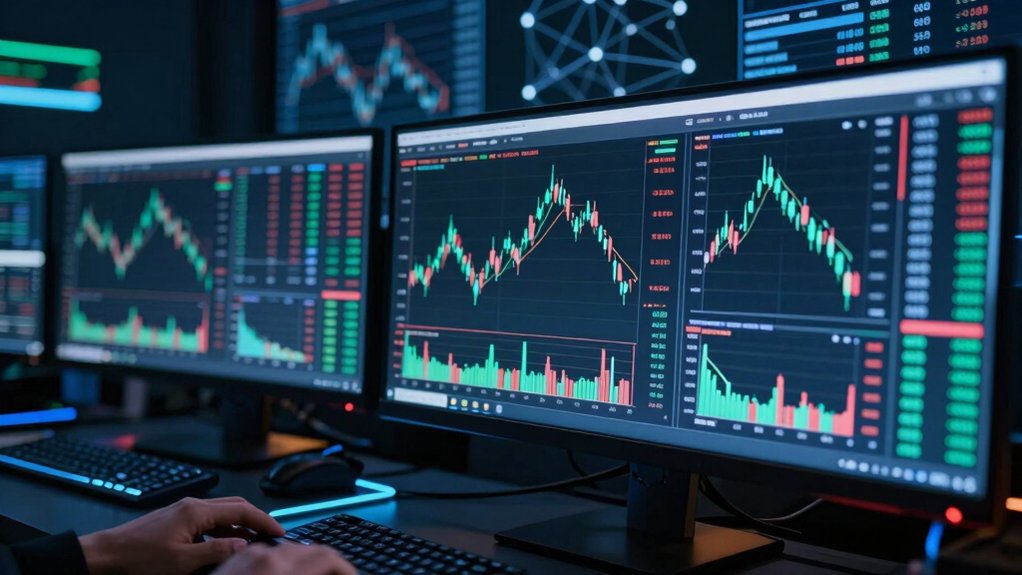

How are artificial intelligence-driven traders reshaping the landscape of crypto prediction markets? These sophisticated algorithms leverage millisecond execution speeds and advanced probabilistic models to exploit subtle inefficiencies in fast-growing digital prediction platforms. By capitalizing on thin liquidity—with typical order-book depths ranging from $5,000 to $15,000 per side—AI traders systematically extract consistent profits from micro-inefficiencies in contract pricing. Across platforms such as Polymarket and Kalshi, which collectively recorded $37 billion in volume by 2025, AI-driven strategies demonstrated their capability to sustain robust returns amid an environment characterized by rapid market expansion and evolving competition. Many of these AI trading systems integrate real-time trading signals powered by machine learning, enhancing their responsiveness and adaptability to market conditions.
The profit margins attained per trade, typically between 1.5% and 3%, translate into significant aggregate gains when executed at scale. Data indicates that a single AI bot executed nearly 9,000 trades, generating approximately $150,000 in profits, while other top-tier wallets accrued multimillion-dollar returns through tens of thousands of trades within a year. These results suggest that neural network-driven models, which integrate diverse data streams such as news sentiment, on-chain indicators, and legislative developments, can identify pricing misalignments that elude human traders. Market makers and arbitrageurs employing AI algorithms deploy pure arbitrage tactics—for instance, simultaneously purchasing complementary YES and NO contracts when their combined price dips below unity—and capitalize on latency discrepancies between exchanges. The average profit per round-trip trade has hovered around $16.80, underscoring the efficiency of these strategies in low-liquidity environments.
Despite these successes, the sustainability of such edges faces increasing pressure. The commoditization of AI tools and the rise in automated participation dilute the previously dominant advantages, compressing profit margins. Projections estimate that revenues in crypto prediction markets, currently leveraged heavily by AI traders, could surpass $10 billion annually by 2030, underscoring growing market maturity and competitive intensity. Additionally, AI copilots that assist human interpretation are beginning to supplant narrow-rule automated agents, indicating a hybrid future for trading strategies.